
Why Choose Mango Wood Furniture for Modern Interiors
- Why Mango Wood Furniture Is Popular in Modern Interiors
- What Is Mango Wood Furniture?
- Why Choose Mango Wood Furniture for Modern Interiors?
- Durability and Strength of Mango Wood Furniture
- Natural Beauty and Unique Designs of Mango Wood
- Eco-Friendly Benefits of Mango Wood Furniture
- Different Types of Mango Wood Furniture for Modern Spaces
- Factors to Consider Before Buying Mango Wood Furniture
- Why Choose Arihant Furniture Crafts for Mango Wood Furniture
- Conclusion: Enhance Your Interiors with Premium Mango Wood Furniture
Durability, character, and everyday practicality — what solid mango wood furniture actually brings to a modern home.
Why Mango Wood Furniture Is Popular in Modern Interiors
Notice something at furniture stores lately? Natural wood is everywhere again. Mango Wood Furniture keeps showing up especially in homes chasing warmth minus the hassle. Homeowners like the grain. Designers like the flexibility. And it just... holds up. No drama, no constant fixing. Modern interiors want pieces that pull double duty — look good, work hard. Not flashy. Just textured, a bit different every time. That's the appeal, really.
What Is Mango Wood Furniture?
Where's it even sourced from? Once mango trees stop bearing fruit reliably, the timber gets a second life instead of going to waste. The wood is dense, moderately hard, takes a finish well. Grain runs differently on every plank — swirling here, fairly straight there, sometimes streaked with darker tones. Not a flaw. Kind of the whole point, actually. Solid Mango Wood Furniture earns its reputation here — clean machining, joinery that holds without cracking. Doesn't warp much once properly seasoned.
Why Choose Mango Wood Furniture for Modern Interiors?
No single reason, really. It's usually a mix of these:
- Holds up to daily use, not just showroom lighting
- Looks a little different every time — no two pieces match exactly
- Bends toward almost any design, chunky or sleek
- Feels more considered than particleboard
- Holds its value over time, not something you'll swap out in two years
For Premium Wooden Furniture shoppers, it's rarely just one factor driving the decision — usually several at once. A dining table has to survive spills; a cabinet has to keep closing properly years later. Mango wood, built well, handles both without much babying — and it takes stain and oil finishes easily, adapting to whatever look a room already has.
Durability and Strength of Mango Wood Furniture
Strong on paper is one thing. Strong with kids running through the living room is another test entirely. Construction matters almost as much as the timber — joinery especially. Done properly, dovetail and mortise-and-tenon joints spread stress in a way plain screws and glue simply can't match. A well-joined piece takes years of real use without a wobble. So, durable? Yes. But only if the joinery was done with some care.
Natural Beauty and Unique Designs of Mango Wood
Grain doesn't repeat — that's really the whole story. Tones shift from pale honey to deep brown, sometimes on the same plank. Designers lean into that instead of fighting it. A Custom Mango Wood Furniture piece often gets shaped to show off a striking swirl in the grain. Finishes vary too: matte oils that keep texture raw, glossier lacquers that smooth things down. Either way, that handmade quality rarely disappears, even in larger production runs.
Eco-Friendly Benefits of Mango Wood Furniture
This one needs some care — sustainability gets used loosely as a marketing word. Mango trees are grown for fruit first, not timber. Once yield drops off commercially, turning the tree into furniture keeps it from going to waste. Genuinely useful, that part. But it doesn't automatically make every Sustainable Wooden Furniture claim true on its own — sourcing, finishing chemicals, and how carefully the manufacturer handles the timber all matter too. A piece built to last does more for sustainability than the raw material alone ever could.
|
FACT: Mortise-and-tenon joinery spreads stress over a wider area than screws manage alone — one reason it's still favored in solid wood builds. |
Different Types of Mango Wood Furniture for Modern Spaces
Mango Wood Dining Tables
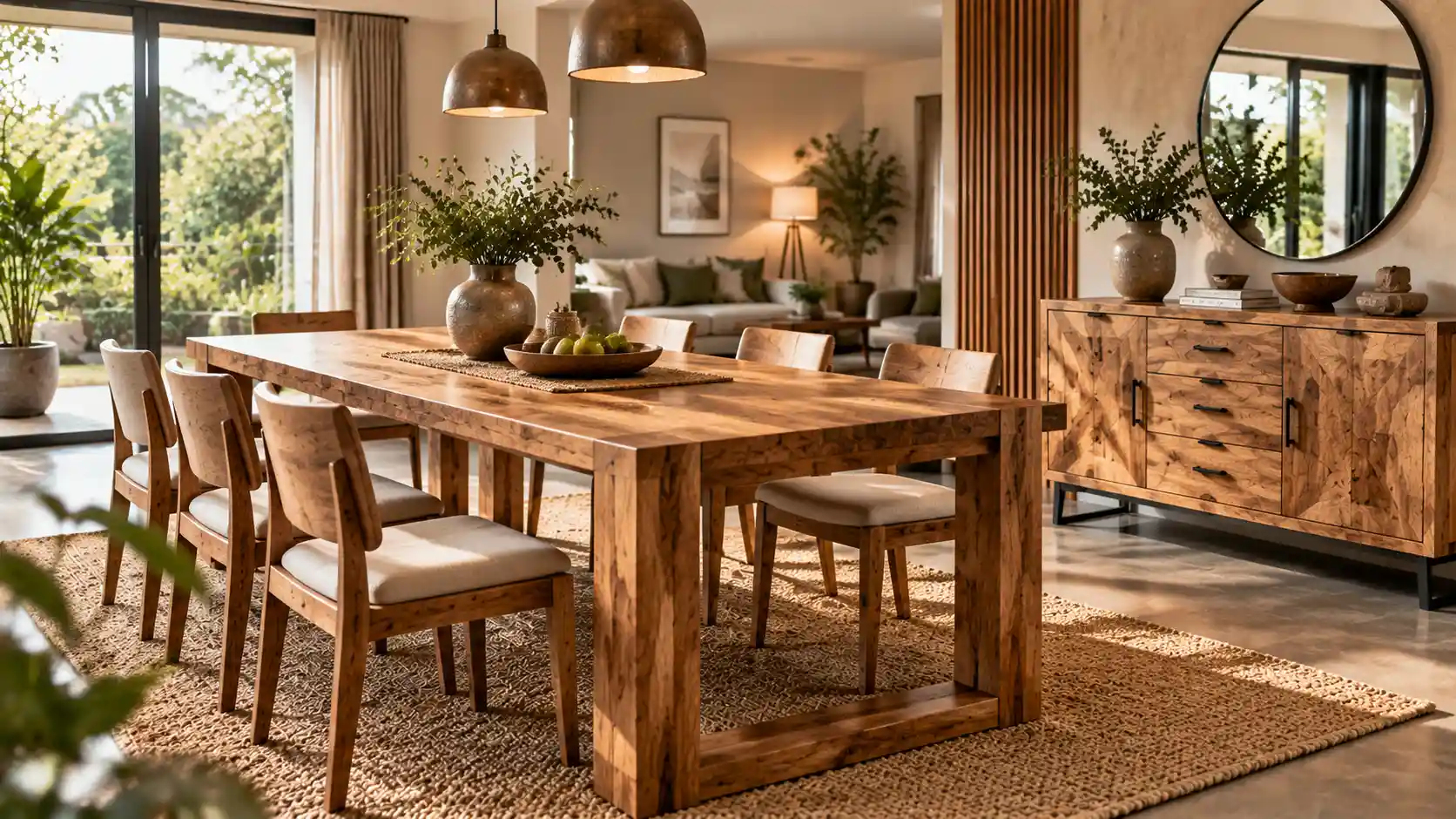
Probably the single most requested piece. The Mango Wood Dining Table helps bring warmth into the room that may otherwise lack some character and durability to survive daily activities, including meals, studying, and even spills at times. Customisations are frequent, such as the shape of the tabletop, leg designs, colours, etc.
Mango Wood Cabinets and Storage Furniture
Storage doesn't need to be dull. Cabinets and sideboards in mango wood add texture to rooms otherwise dominated by flat surfaces — kitchens, hallways, dining spaces. Drawers that glide, doors that shut flush: function stays the priority. The grain just keeps it from feeling purely utilitarian.
Mango Wood Coffee Tables and Accent Furniture
Smaller pieces — coffee tables, side tables, benches — punch above their size. Buyers experiment more here, since the commitment is lower than a full dining set. Decorative, but still useful. The small entryway bench even ends up carrying more load than expected.
How Mango Wood Furniture Complements Different Interior Styles
Can one species really work across every style? Surprisingly, yes — mostly down to the finish. Clean metal legs and muted colors, it slots into modern or Scandinavian rooms. Visible grain under matte oil, it suits rustic or industrial spaces. Traditional interiors lean toward richer stains; transitional spaces borrow from both. The wood stays neutral enough to take direction from whatever's around it — hardware, upholstery, wall color do more of the styling work than the timber itself.
|
DID YOU KNOW?: A single plank of mango wood can shift from pale gold to deep brown, so pieces from the same batch rarely look exactly alike. |
Factors to Consider Before Buying Mango Wood Furniture
Worth slowing down before buying. Check these first:
- Wood quality — even seasoning, no visible cracks
- Joinery — screws alone won't hold up over years
- Finish — oil and lacquer age very differently
- Craftsmanship — edges, joints, whether drawers sit level
- Fit — does it actually suit the room already?
- Customization — can size or tone be adjusted at all?
- Upkeep — some finishes ask for a lot more attention
- Who's making it — process matters more than price alone
Skip these, and it tends to surface later — a joint that wobbles, a finish that wears unevenly within a year or two.
| Furniture Application | Why Mango Wood Works Well | Suitable Interior Styles | Key Buying Consideration |
|---|---|---|---|
| Dining Tables | Durable construction and natural grain | Modern, rustic, contemporary | Tabletop quality and joinery |
| Cabinets & Storage | Strong material with visual character | Modern, industrial, traditional | Finish and hardware |
| Coffee Tables | Natural texture and versatile design | Contemporary, Scandinavian, rustic | Surface finish and stability |
| Accent Furniture | Decorative appeal with functional use | Modern, transitional, eclectic | Craftsmanship and design |
TRIVIA: Mango trees can bear fruit for over a century — part of why their timber only enters furniture production once fruit yield declines.
Why Choose Arihant Furniture Crafts for Mango Wood Furniture
Arihant Furniture Crafts works with wooden furniture specifically, mango wood among the regular materials. As a Mango Wood Furniture Manufacturer in India, the focus stays on craftsmanship and how a piece is actually built — those two things decide whether it lasts. Buyers wanting something shaped to their own space have customization options to work with. Comparing wooden furniture suppliers? Ask direct questions about construction and finish before deciding — that tells you more than a spec sheet.
Conclusion: Enhance Your Interiors with Premium Mango Wood Furniture
Durability. Natural beauty. Versatility. Mango wood furniture brings all three together in a way synthetics can't fake. None of it means much without solid construction behind it, though. Pick pieces with proper joinery, a responsible finish, shaped for the space they'll sit in. Done right, it's not a short-term buy — it ages well, both in how it holds up and how it looks doing it.
|
Take a look at Arihant Furniture Crafts' Mango Wood Furniture range and find pieces built for how you actually live, not just how a showroom looks. |
Honestly, it comes down to construction. The wood itself isn't the deciding factor — joinery is. Go with dovetail or mortise-and-tenon over a basic screws-and-glue setup, and there's really no contest in how long it lasts. Add a solid finish on top, and daily wear barely puts a dent in it. Skip the joinery, though, and durability drops fast.
Not quite that simple, no. Mango trees get grown for fruit first — timber comes later, once yield tapers off, so putting that wood to use beats letting it go to waste. That part's fair. Slapping a sustainable label on every single piece, though, glosses over what actually matters — where it's sourced, what's in the finish, and whether the thing lasts long enough to justify the claim.
Nothing too demanding, honestly. A dry or barely damp cloth handles most dusting. Skip harsh chemical cleaners — they do more harm than good. People underestimate direct sun — it does more damage than harsh cleaners ever would, so keep pieces out of it when you can. An occasional oil refresh stops the finish from drying out over time.
Mostly comes down to cost and grain. Teak and sheesham run denser, pricier, and more uniform in tone. Mango wood costs less and shows far more character in the grain — lighter patches, darker streaks, sometimes both on a single plank. Not weaker by any means, just a different look and price point.
Usually, yeah. It's a workable timber, so adjusting dimensions, shapes, or finish tones isn't much of an ask for most manufacturers. Want a particular tabletop size, or a specific stain? Chances are someone can build it. Just factor in lead time, though — custom pieces take longer than what's already sitting in stock.
Both, honestly. Bigger pieces obviously need bigger rooms, but smaller items — side tables, benches, compact cabinets — slot into tight spaces without any trouble. The grain brings warmth without visually crowding things, which oddly enough helps small rooms feel less bare. Scale and finish end up mattering more than the wood.