
Office Storage Cabinet Buying Guide | Arihant Furniture
- What is an Office Storage Cabinet?
- Why is it Important?
- Types and Variants
- Features to Look For
- Product Overview
- Benefits
- Applications and Use Cases
- Comparison Table: Storage Cabinet Types at a Glance
- Expert Tips and Buying Guide
- Conclusion
Because most offices don't need more furniture — they need furniture that actually organizes something.
Walk into most offices and the storage problem is obvious within about ten seconds — files stacked here, cables tangled there, a printer buried under old catalogues nobody's thrown out yet. Rarely does anyone plan for this on purpose. Storage just gets pushed to the end of the list, and by the time someone notices, there's nowhere left to put anything. A decent office storage cabinet solves most of that in one go. Not glamorous, but it keeps files findable and desks usable, which honestly counts for more. This guide runs through what matters before you buy — types, materials, features, the details that decide whether a cabinet survives ten years or falls apart in two. Single cabin or full floor, the same basics apply to office storage furniture.
What is an Office Storage Cabinet?
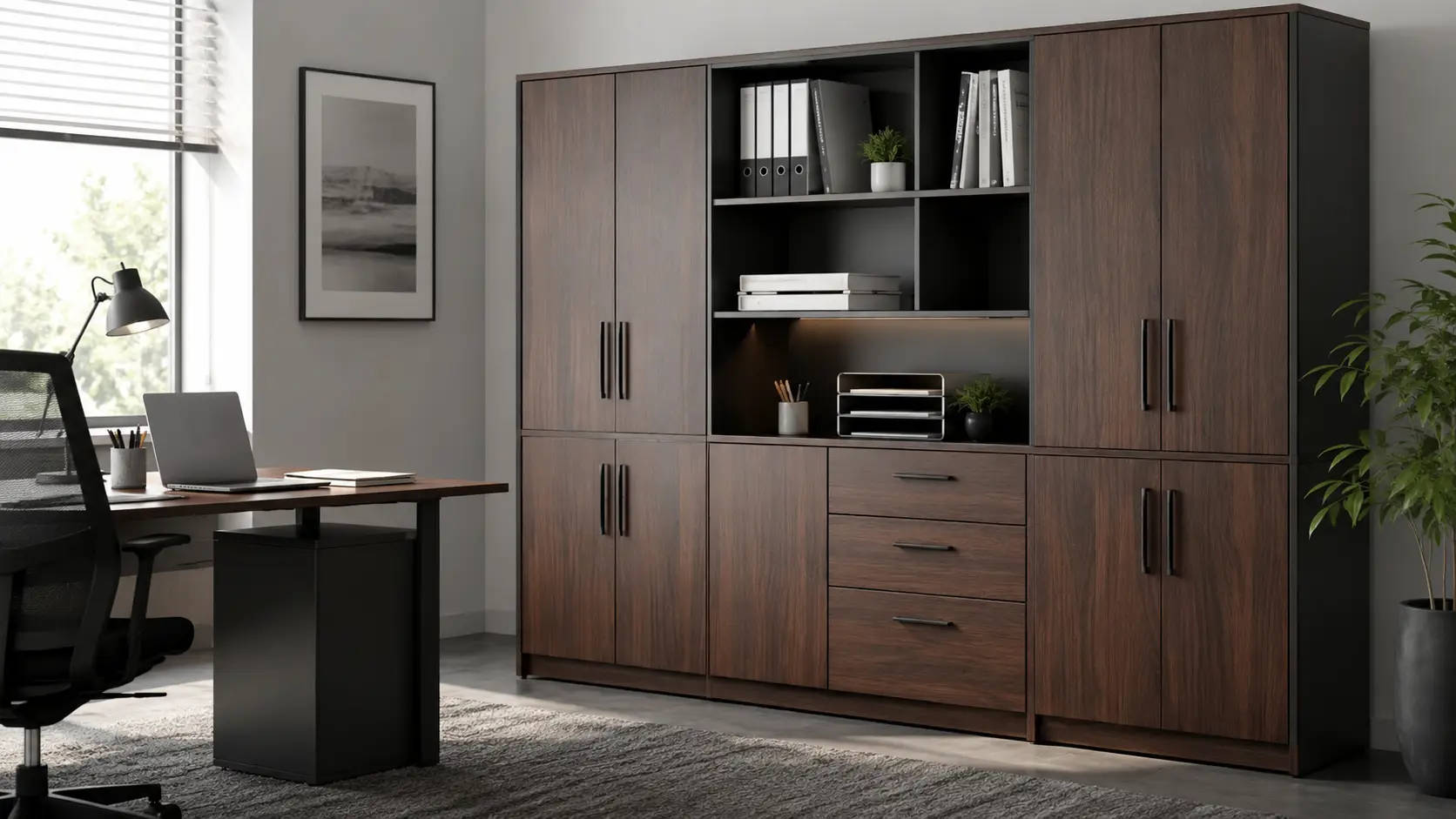
At its core, this is an enclosed unit — something built to hold documents, stationery, electronics, whatever needs to stay off the desk and out of view. Open shelves gather dust fast; office storage cabinets hold up a lot longer. Sizes vary wildly too — a narrow two-shelf piece under a desk on one end, a floor-to-ceiling cupboard running an entire wall on the other. Picking the right storage cabinet for office use comes down to more than looks, though. It has to match how the team actually works, how much needs storing day to day, and how often someone's opening that door.
Why is it Important?
A messy office slows everyone down. Hunting for a misplaced file. Digging through drawers for a charger nobody can find. Papers stacked on an already crowded desk, spilling onto the next one. None of this is about decoration, really. Storage protects sensitive documents, keeps the place looking sharp when clients walk in, and cuts down the small daily friction nobody talks about. Plan office storage cabinet placement early, and clutter stops being a recurring fire to put out — teams just stop generating it in the first place.
- Keeps confidential files out of casual reach
- Frees up desk space — nobody works well buried under stacks
- Protects equipment and documents from dust, spills, damage
- Makes a tidier, more credible impression when clients walk in
- Cuts down the daily time wasted hunting for things
Types and Variants
Not every office needs the same cabinet — obvious, maybe, but easy to forget once you're three catalogues deep. Some spaces need height. Others need width. Sometimes it's just one lockable drawer for the petty cash box, nothing more.
- Vertical filing cabinets — tall, narrow, built for folders
- Lateral cabinets, wider and shallower, work well in open-plan areas
- Storage cupboards with shelves for books, binders, supplies — flexible
- Mobile pedestal units, small and wheeled, sit right under the desk
- Wood storage cabinets — solid, warm-looking, built to outlast most trends honestly
- Mixed-material units, metal frame plus wooden panels, for extra sturdiness
Funny enough, the same joinery used in Wood storage cabinets for offices carries over into home furniture too. A well-built storage cabinet for clothing uses nearly the same hinge and shelving logic — just scaled down for a wardrobe instead of a filing wall.
Features to Look For
Check these before signing off on a purchase order. Easy to skip. Expensive to regret.
- Lockable doors or drawers for confidential material
- Adjustable shelving, because needs change every year
- Sturdy hinges and runners that won't sag under load
- Fire-resistant or moisture-resistant finish where documents matter
- A footprint that fits your actual floor plan, not just the catalogue photo
- Hardware that survives daily open-close use without loosening
Product Overview
Office storage furniture has moved past the plain metal-box look most people still picture. Clean lines. Soft-close drawers. Finishes built to sit well in a modern interior, not clash with it. Reputable Storage Cabinet Manufacturers build units now that work in a boardroom just as easily as a back-office archive room — function first, but never at the cost of how the thing actually looks. Getting that balance right is trickier than it sounds.
Benefits
- Better organization — everything has a place, stays there
- Improved workflow, less time lost searching
- A cleaner, more professional workspace look
- Longer document lifespan thanks to dust and moisture protection
- Space efficiency, especially in compact or shared offices
- Room to scale — add units as the team or paperwork grows
Applications and Use Cases
Storage needs shift depending on where you're standing. A reception area might just need a slim cupboard for brochures. A finance team needs lockable, fire-aware units, full stop.
- Corporate offices — filing, records, confidential documents
- Co-working spaces — shared, lockable units per member
- Reception and lobby areas — tidy storage for stationery, brochures
- Conference rooms — housing AV gear, cables, supplies
- Back-office archives — long-term record retention
Comparison Table: Storage Cabinet Types at a Glance
| Cabinet Type | Best For | Storage Style | Typical Material |
|---|---|---|---|
| Vertical Filing Cabinet | Document-heavy roles | Drawer-based | Metal or engineered wood |
| Lateral Cabinet | Open-plan shared teams | Wide drawers/shelves | Metal, laminate, or wood |
| Storage Cupboard | Supplies and shared storage | Shelved, door-enclosed | Solid or engineered wood |
| Mobile Pedestal | Individual desk use | Compact drawers | Metal or wood composite |
| Wooden Cabinet | Long-term, premium storage | Doors, shelves, drawers | Solid wood |
Expert Tips and Buying Guide
Before finalizing a vendor, take a step back. This isn't a one-time decision — it's furniture you'll open and close hundreds of times a year.
- Measure the actual space, not just what looked good in the showroom
- Ask about warranty and after-sales support before committing
- Compare finishes — laminate is cheaper, solid wood ages better
- Check load capacity for heavy files or equipment
- Go with suppliers who have proven delivery timelines for bulk orders
- Don't skip ventilation. Closed cabinets need airflow, or dampness creeps in
Sourcing at scale? Working with established Office Furniture Manufacturers in India makes life easier — bulk orders, consistent finishing, timelines you can actually count on. That beats chasing a slightly cheaper quote from someone unverified. Most established office furniture manufacturers also offer customization on size, finish, and internal layout, which matters, since no two office floor plans look quite the same. Small extra step during procurement. Saves real headaches six months down the line.
Conclusion
Picking the right cabinet isn't about grabbing the first one that fits the corner. It's matching material, size, and function to how your office actually runs, day to day, week after week. Sleek metal or the warmth of solid wood — the goal stays the same: a workspace that stays organized without you having to think about it constantly. Reliable Storage Cabinet Suppliers in India and trusted Storage Cabinets Manufacturers in India can get you there, with options built for everyday, long-term use. Good storage, in the end, is the kind you stop noticing. Because it just works, quietly, in the background.
| Ready to organize your workspace? Explore durable, customizable storage cabinets built to fit your office, right here at Arihant Furniture Crafts. |
Depends on the space, honestly, more than anything else. Measure the wall first — height, width, depth — before you look at catalogues. Go too big and the room just feels smaller, weirdly. A mid-height unit covers most offices fine — bump up only if paperwork genuinely piles up that much.
Solid wood wins if longevity matters more than the price tag upfront. It ages better, shrugs off daily wear, and you're not replacing it every few years. Engineered wood costs less and still looks decent, but won't survive as long under heavy office use. Metal sits in between — sturdy, less warm-looking, low maintenance.
Pretty much, yes — more than most people expect going in. Good manufacturers work with your size, shelf count, finish, even door style, so the cabinet fits that awkward corner instead of you rearranging the office around a stock catalogue size. Just bring it up early, before the order's locked in.
Check the joinery, not just the finish. Solid hinges, drawer runners that don't wobble, and a frame that doesn't flex when you push on it — these matter more than a glossy coat of paint. Ask about warranty terms too. A supplier confident in their build will usually back it without hesitation
Not every desk needs one, but somewhere in the office, yes — almost always. Finance records, HR files, anything confidential needs a lockable unit at minimum. Reception areas or supply closets can usually skip it. Look at what's actually going inside before deciding — locks matter where it counts, dead weight everywhere else.
Falling for looks first and skipping the load capacity or actual measurements against the room. A cabinet that photographs well can still sag under heavy files within a year. Measure twice, ask about materials, and don't skip the boring questions — warranty, delivery timelines, after-sales support. That's usually where real problems show up.