
What to Look for in a Reliable Wooden Furnitures Manufacturer
- Why Choosing the Right Wooden Furniture Manufacturer Matters
- Check the Quality of Wood and Raw Materials
- Types of Wood Used in Furniture Manufacturing
- Evaluate Manufacturing Capabilities and Infrastructure
- Look for Customization and Design Flexibility
- Understand Quality Control and Finishing Standards
- Consider Bulk Order, Packaging and Delivery Capabilities
- Compare Pricing Without Compromising on Quality
- Mango, Sheesham and Acacia — A Quick Comparison
- Questions to Ask Before Selecting a Wooden Furnitures Manufacturer
- Conclusion
Everything a B2B buyer should check before committing to a bulk wooden furniture order — material, customization, production, and delivery.
Stocking a hotel chain or a retail rollout isn't the same as picking a single chair for home. Scale magnifies mistakes fast — shipments slip, finishes stop matching batch to batch, timber warps before the season is even over. Selecting the right Wooden Furnitures Manufacturer is what prevents all three. Retailers, hospitality brands, exporters, interior firms — they all need a partner who delivers the same quality on order fifty as on order one. What follows breaks down the real differences between a dependable Wooden Furniture Manufacturers in India and a name that only impresses on a catalogue page — the kind of scrutiny we apply to our own process at Arihant Furniture Crafts.
Why Choosing the Right Wooden Furniture Manufacturer Matters
Get this one decision right and everything downstream falls into place — delivery-day appearance, how long the pieces last, whether the customer orders again. Specs should stay identical batch after batch. Deadlines should hold without excuses. And a good Wooden Furniture Manufacturer keeps answering your calls long after the invoice clears, not just while it's pending. Get it wrong and the damage lands fast — stock coming back, a reputation taking hits, margins quietly disappearing into rework. Twenty pieces or two thousand, a solid Wooden Furniture Supplier doesn't change its discipline with order size.
Check the Quality of Wood and Raw Materials
Ten years of use versus two years of complaints — the gap usually traces back to the timber. Sourcing, seasoning time, and moisture control before the first cut all play a part.
Get these answers before you sign anything, not after — start with:
- 8–12% moisture content before cutting starts — go higher than that and warping becomes a matter of when, not if.
- Kiln-dried or air-dried — either works, but ask exactly how long that drying process took.
- Request a raw material certificate or mill test report for bulk orders.
- Does the Solid Wood Furniture Manufacturer grade wood before use, or mix inferior batches in?
- One excellent piece means little if the next fifty don't match it — shipment-to-shipment consistency is the real test.
Types of Wood Used in Furniture Manufacturing
Wood choice should follow the product, not the other way round. Sheesham Wood Furniture is dense, dark-grained, and built for daily wear; Mango Wood Furniture trades some of that weight for a lighter look and a gentler price tag. Acacia splits the difference — tough, distinctively patterned, and easy on the budget. Ask which species actually fits your product line. "Whatever's cheapest this month" is an answer, technically — just not a reassuring one.
Trivia: “Sheesham wood once went into railway sleepers across India, valued for resisting decay and insects. Modern dining tables and cabinets lean on that same density for a reason.”
Evaluate Manufacturing Capabilities and Infrastructure
A showroom sample tells you nothing about scale. The real test comes when an order jumps from 50 units to 500 — that's where a Wooden Furniture Manufacturing Company either holds up or falls apart.
Here's what actually separates the two:
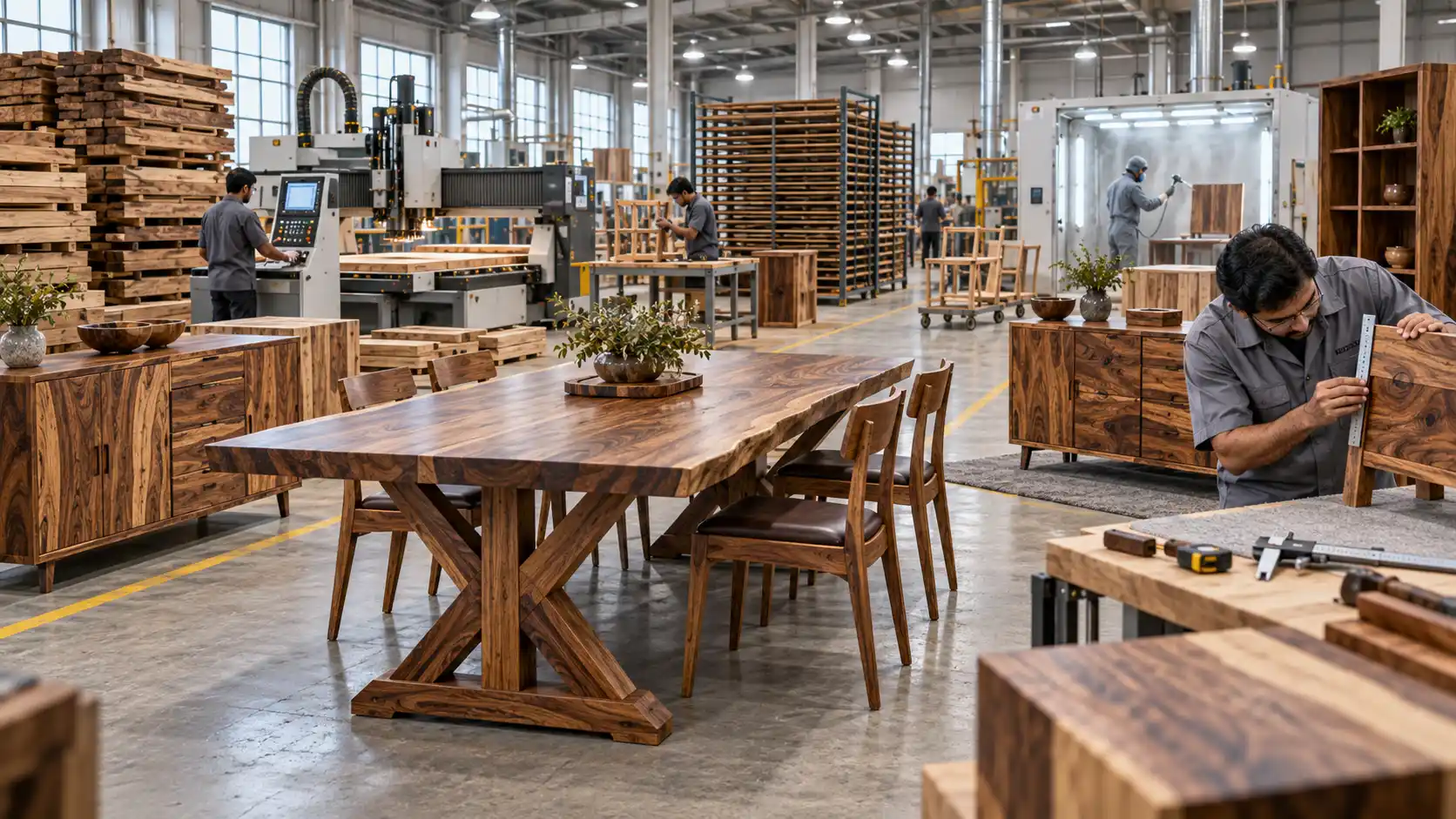
- Don't stop at the sample room. Walk the factory floor and check for CNC cutting, kiln facilities, and spray-finishing booths.
- Skilled carpenters or semi-automated lines — neither one wins outright, but each shifts the trade-offs differently.
- Ask for monthly production capacity in actual units, not a vague promise over the phone.
- In-house finishing beats outsourced work here, mostly because outsourcing tends to stretch out lead time.
- Can the unit handle a Bulk Wooden Furniture Supplier requirement without farming out the whole order?
- Peak-season capacity is worth asking about directly — festive demand and hospitality deadlines expose weak planning fast. It's the kind of stress-test Arihant Furniture Crafts plans production around well ahead of the festive rush.
Look for Customization and Design Flexibility
Standard catalogues rarely cover what a real project brief needs. Hotels want matching finishes across hundreds of rooms; retailers want dimensions that fit shelf space exactly, down to the centimetre.
Here's what to look for:
- Need custom dimensions down to the centimetre? Space-constrained interiors usually do.
- Finish options should stretch beyond the standard three — matte, glossy, distressed, natural, matched against your actual brand palette.
- Colour matching happens against existing stock or a design mood board, not guesswork.
- Design consultation, not just order-taking — that's what separates a real Custom Wooden Furniture Manufacturer from a factory that just cuts to spec.
- Get prototype or sample approval locked in before full production starts; skipping this step is where customization disasters usually begin — something Arihant Furniture Crafts builds into every custom order by default.
Understand Quality Control and Finishing Standards
Finishing hides flaws better than any other step in the process — and it's where most buyers get burned.
Ask how they handle each of these:
- Joints get tested under load — dovetail, mortise-and-tenon, dowel, whatever the design calls for.
- Every piece gets checked against the approved drawing. Dimensional accuracy isn't optional at scale.
- Sanding marks, uneven polish, colour mismatch — surface flaws hide well in photos but not in person.
- Is inspection happening at multiple stages, or just once before the box gets sealed?
- Ask for photos or video of Furniture Quality Control checkpoints while production is still running.
Did you know? “Properly seasoned solid wood furniture can last three to four generations with basic care. Poorly dried timber, on the other hand, can crack or warp within its very first humid season.”
Consider Bulk Order, Packaging and Delivery Capabilities
A beautiful piece that arrives cracked is worthless. Export-grade packaging and realistic timelines separate professional suppliers from the rest.
Check for the following before you commit:
- Corner protection, corrugated wrapping, crate packing — long-distance shipping punishes anything less.
- Does the container loading plan actually maximise space, or does it just look efficient on paper?
- Lead times should be documented in writing, for both domestic and international orders.
- Real export experience shows in the paperwork. A genuine Wooden Furniture Exporter India can produce past shipment records without digging.
- Insurance coverage and a damage-replacement policy — ask for both, stated upfront, before the first container ships.
- Tracking and delivery updates from a Wholesale Wooden Furniture Supplier should arrive without you having to chase them down.
Fact: “India ranks among the world's leading wooden furniture exporting nations. Hand-crafted solid wood pieces from hubs like Rajasthan ship regularly to the USA, Europe, and the Middle East — a standard Arihant Furniture Crafts holds itself to on every export order.”
Compare Pricing Without Compromising on Quality
The lowest quote almost never stays the lowest cost once replacements, delays, and complaints get added up. Compare what's actually included first — wood grade, hardware quality, finishing coats, packaging standard — and only then compare numbers. Quoting well below market usually means corners are getting cut somewhere, whether or not it shows on the price sheet; that's true of any Wooden Furniture Supplier, budget or premium. Judge value across the full order lifecycle, not just the invoice, especially when sourcing Wholesale Wooden Furniture for repeat business.
Mango, Sheesham and Acacia — A Quick Comparison
| Attribute | Mango Wood | Sheesham Wood | Acacia Wood |
|---|---|---|---|
| Durability | Moderate, good for daily use | High – built for heavy use | Strong and hard-wearing |
| Grain Pattern | Light streaks, subtle look | Dark – rich and grainy | Wavy, distinctive grain |
| Best Suited For | Everyday home pieces | Dining sets, heavy-use furniture | Statement or industrial-style pieces |
| Relative Price | Easiest on the wallet | Costs more, lasts longer | Sits in the middle |
Questions to Ask Before Selecting a Wooden Furnitures Manufacturer
Run through this before the first purchase order goes out — it beats months of back-and-forth afterward.
Before signing anything, ask:
- What's the minimum order quantity, and does it flex for new buyers?
- Which wood species and grades are used by default?
- Can they share references or past export documentation?
- How long does a sample take, and is it chargeable?
- What's the standard lead time from confirmation to dispatch?
- How is packaging handled for international shipping?
Get straight answers to all six, and you're most of the way to picking a Reliable Wooden Furnitures Manufacturer you won't regret working with.
Conclusion
Choosing a manufacturer isn't just a sourcing decision — it's a long-term partnership. Wood quality, production capacity, customization, finishing standards, delivery reliability: all of it factors into whether that partnership survives past the first order. Repeat business, not a one-off transaction, is what a real Wooden Furnitures Manufacturer is actually built for.
Evaluating your next bulk order? Put a Custom Wooden Furniture Manufacturer's process under scrutiny end-to-end before committing — reach out to Arihant Furniture Crafts and put ours to the test. Six months from now, that upfront checking is exactly what keeps you out of trouble.
Raw material quality, first. Ask about moisture content, seasoning method, and wood grading before price or design even come up — a manufacturer who can't explain sourcing clearly is usually hiding something. Once material checks out, move to production capacity, customization options, and lead times you can actually verify in writing.
Ask for their stated monthly capacity — in actual units, not a rounded-up guess. A genuine Bulk Wooden Furniture Supplier can produce factory photos, past shipment records, and live references without hesitation. If the answers get vague or the manufacturer stalls, that reluctance is the answer you actually need.
Usually, yes. Non-standard cutting and lower material efficiency add roughly 10–20% over catalogue pricing, though complexity swings that number either way. For hospitality projects or tight interiors, though, the fit you gain from custom sizing tends to justify the extra cost over time.
GST registration, an IEC (Import Export Code), export packaging certifications — that's the baseline. Established manufacturers go further, keeping mill test reports and inspection records for every shipment. Those documents matter most at customs clearance, and their absence is usually a sign the business isn't truly export-ready.
Expect two to four weeks on average, though design complexity and wood-species availability can stretch that. Prototype fees vary too — some manufacturers charge upfront, others waive it once a bulk order is confirmed. Get the sample cost and turnaround confirmed in writing early — delays here tend to predict delays later.
Most established ones do, yes. Commercial and hospitality work usually demands tighter finish consistency and faster turnaround than a single residential order ever would. Ask how they've matched finishes across large quantities before — that track record matters more than a simple yes or no.